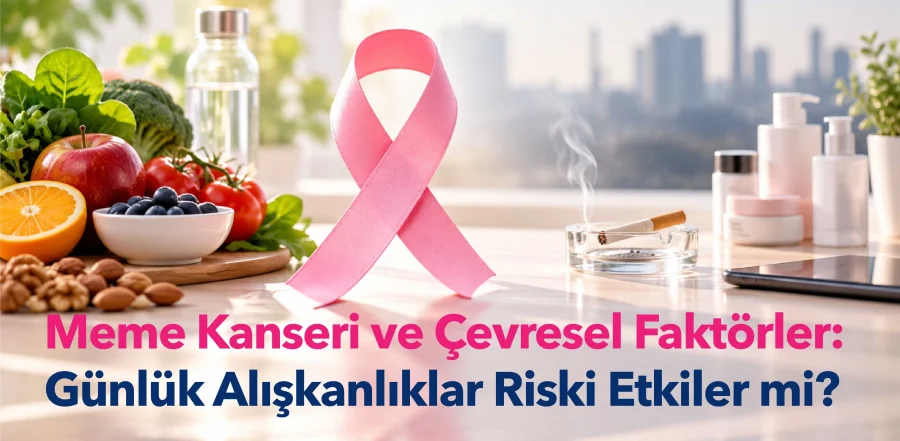
Breast Cancer and Environmental Factors: Can Everyday Habits Affect the Risk?
The Relationship Between Breast Cancer and Environmental Factors
Drinking water from plastic bottles, using deodorant, working night shifts, or consuming certain foods are everyday habits that often raise questions about breast cancer risk. However, these claims need to be evaluated in light of scientific evidence.
Breast cancer develops when certain cells in breast tissue begin to grow uncontrollably. Age, genetic characteristics, family history, hormonal factors, and certain lifestyle habits may influence the likelihood of developing the disease. Researchers are also investigating the potential effects of environmental chemicals and work schedules that affect the body's biological clock.
An important distinction must be made: the fact that a substance produces a biological effect in the body does not necessarily mean that it causes breast cancer. Similarly, finding an association between two factors does not automatically establish a cause-and-effect relationship.
What does scientific evidence tell us about common everyday habits?
1. Does Drinking Water from Plastic Bottles Increase Breast Cancer Risk?
Certain chemicals found in plastic products are being studied because of their potential effects on the hormonal system. The effects of microplastics on human health are also an ongoing area of research.
However, there is currently insufficient scientific evidence to establish that drinking water from plastic bottles directly causes breast cancer. Effects observed in laboratory studies cannot automatically be assumed to occur in humans under everyday exposure conditions.
For this reason, plastic bottle use should not be described as an established cause of breast cancer. When assessing environmental chemicals, researchers consider the properties of the substance, the level of exposure, and findings from human studies.
2. How Do Hormones Influence Breast Cancer Risk?
Hormones play an important role in the development and function of breast tissue. The duration of hormonal exposure throughout life and the use of certain hormone therapies may therefore be relevant when assessing breast cancer risk.
Some hormone therapies used during menopause can affect breast cancer risk. For combined therapies containing estrogen and progestin, risk may vary depending on the treatment's duration, formulation, and the individual's medical history. Not all hormone therapies have the same risk profile.
Researchers are also investigating whether certain environmental chemicals can affect the hormonal system. However, evidence that a chemical affects hormones does not, by itself, prove that it causes breast cancer.
Decisions about hormone-containing medications or menopausal hormone therapy should be made with a healthcare professional, taking individual needs, medical history, potential benefits, and risks into account.
3. Is Working Night Shifts Associated with Breast Cancer?
The human body has an internal biological clock that regulates the sleep-wake cycle. Night work, frequently changing sleep schedules, and exposure to light at unusual times can affect this rhythm.
The relationship between night-shift work and cancer risk has been studied for many years. The International Agency for Research on Cancer (IARC) has classified night-shift work that disrupts circadian rhythms as probably carcinogenic to humans.
This classification indicates that scientific evidence suggests a potential risk. It does not mean that everyone who works night shifts will develop breast cancer or that night work alone necessarily causes the disease.
Shift frequency, duration of employment, and other individual risk factors should also be considered. Maintaining a regular sleep schedule and getting adequate rest are beneficial for general health, but they cannot be assumed to eliminate any potential risks associated with night work.
4. Can Insufficient Sleep Cause Breast Cancer?
Sleep plays an important role in maintaining normal bodily functions. Insufficient sleep can affect attention, energy levels, and mood. Researchers are also studying the relationship between sleep patterns, circadian rhythms, and cancer risk.
However, there is insufficient evidence to conclude that sleeping too little, on its own, directly causes breast cancer. Studies of sleep habits need to account for night-shift work, lifestyle factors, and other variables.
Keeping a reasonably consistent sleep schedule and allowing enough time for rest support general health. Nevertheless, regular sleep should not be considered a proven way to prevent breast cancer.
5. Does Using Deodorant Increase Breast Cancer Risk?
The claim that deodorants and antiperspirants cause breast cancer frequently raises concerns, particularly regarding the ingredients in these products.
Current scientific evidence does not establish that the ordinary use of deodorants or antiperspirants causes breast cancer. Questions about an ingredient do not necessarily mean that the substance has been proven to cause breast cancer under normal conditions of use.
Therefore, there is no established benefit to stopping deodorant use solely to prevent breast cancer. Product ingredients, usage instructions, and individual sensitivities may be considered when choosing personal care products.
6. Does Wearing a Bra Affect Breast Cancer Risk?
Claims that wearing a bra causes breast cancer or that going without one reduces the risk occasionally circulate.
However, there is insufficient scientific evidence to establish a direct cause-and-effect relationship between wearing a bra and breast cancer. Bra type, duration of use, and going without a bra are not established methods of breast cancer prevention.
Wearing a bra is a matter of personal comfort and preference. When considering breast cancer risk, it is more appropriate to focus on scientifically established risk factors rather than unverified claims.
7. Can Broccoli and DIM Prevent Breast Cancer?
Vegetables such as broccoli, cabbage, and cauliflower contain compounds involved in various biological processes. Some of these compounds are being investigated in laboratory studies for their potential effects on mechanisms associated with cancer.
One such compound is DIM, or 3,3'-diindolylmethane. However, laboratory findings do not prove that eating broccoli or taking DIM supplements prevents breast cancer in humans.
Broccoli and similar vegetables can be part of a varied, balanced diet. However, a food being healthy does not mean that it has been proven to prevent a particular type of cancer.
Anyone considering supplements such as DIM for breast cancer prevention should consult a healthcare professional. These products should not be regarded as a way to eliminate cancer risk or as a substitute for a balanced diet.
8. Does Drinking Coffee Increase Breast Cancer Risk?
The relationship between coffee consumption and breast cancer has been examined in scientific studies. However, there is insufficient evidence to establish that drinking coffee directly causes breast cancer. Similarly, stopping coffee consumption has not been shown to prevent the disease.
The potential health effects of coffee can be considered in relation to the amount consumed, overall health, and dietary habits.
Focusing on a single beverage may distract from the broader range of factors that influence breast cancer risk. Coffee consumption alone is not a reliable measure of an individual's breast cancer risk.
9. Is Constipation Associated with Breast Cancer?
Constipation can be associated with dietary habits, fluid intake, physical activity, medications, and certain health conditions. However, there is insufficient scientific evidence that constipation directly causes breast cancer.
Digestive problems should be assessed separately from breast cancer risk. Although addressing constipation is important for digestive health, it should not be presented as a method of breast cancer prevention.
Persistent or newly developing constipation, particularly when accompanied by other symptoms, should be evaluated by a healthcare professional.
10. Can Vitamin D Prevent Breast Cancer?
Vitamin D is essential for several bodily functions, particularly bone health. Researchers are also investigating possible relationships between vitamin D levels and different types of cancer.
However, vitamin D supplementation has not been established as a method of breast cancer prevention. The fact that a vitamin is necessary for the body does not mean that taking more of it reduces cancer risk.
People with vitamin D deficiency should have their needs assessed according to their individual health circumstances. High-dose supplements should not be taken without guidance from a healthcare professional.
Vitamin D is important when needed to correct a deficiency, but it should not be regarded as a stand-alone protective measure against breast cancer.
11. Can Dental Checkups Prevent Breast Cancer?
Regular dental checkups help maintain oral health. However, there is no established scientific evidence that dental visits prevent breast cancer.
While oral health care remains important, breast health assessments must also be carried out separately. Preventive measures in one area of healthcare cannot replace screening or preventive measures for another disease.
What Can You Do to Reduce Breast Cancer Risk?
No method can guarantee complete prevention of breast cancer. Nevertheless, it is important to pay attention to certain modifiable risk factors and understand your individual risk.
Stay physically active
Regular physical activity supports overall health and is among the lifestyle factors associated with a lower risk of breast cancer. Activity levels should be appropriate for an individual's health and physical abilities.
Limit alcohol consumption
Alcohol consumption is associated with an increased risk of breast cancer. Reducing alcohol intake or avoiding alcohol may therefore be considered when addressing modifiable risk factors.
Maintain a healthy body weight
Excess body weight, particularly after menopause, is associated with an increased risk of breast cancer. A balanced diet and regular physical activity can help maintain a healthy body weight.
Consider your family history
A family history of breast cancer is important when assessing individual risk. If multiple close relatives have had breast cancer, or the disease occurred at a young age in the family, a healthcare professional can help assess personal risk.
Discuss hormone therapy with a healthcare professional
The potential benefits and risks of hormone therapy used during menopause vary from person to person. Treatment decisions should be made with a healthcare professional, taking medical history and individual needs into account.
Keep up with breast health assessments
The appropriate timing and method of breast cancer screening depend on age, individual risk, and current health guidelines.
Changes such as a new breast lump, skin dimpling or retraction, newly inverted nipple, or spontaneous discharge from one breast should be medically evaluated. These changes do not necessarily indicate breast cancer, but their causes should be investigated.
Frequently Asked Questions About Breast Cancer and Environmental Factors
What are the main risk factors for breast cancer?
Age, certain genetic changes, family history, breast density, reproductive history, some hormone therapies, and alcohol consumption are among the factors associated with breast cancer risk. Having one or more risk factors does not mean that a person will inevitably develop the disease.
Do plastic bottles and deodorants cause breast cancer?
There is insufficient scientific evidence that the ordinary use of these products directly causes breast cancer. They should therefore not be described as established causes of the disease.
Does working night shifts definitely cause breast cancer?
No. The potential relationship between night-shift work and cancer risk is being investigated. Certain forms of night-shift work that can disrupt circadian rhythms have been classified by IARC as probably carcinogenic. This does not mean that everyone who works night shifts will develop breast cancer.
Can broccoli or vitamin D supplements prevent breast cancer?
Vegetables such as broccoli can be part of a balanced diet. However, broccoli, DIM, and vitamin D supplements have not been proven to prevent breast cancer.
Is it possible to prevent breast cancer completely?
There is no method that can guarantee complete prevention of breast cancer. Paying attention to modifiable risk factors, understanding individual risk, and following screening recommendations appropriate to age and risk level are important.
Conclusion: Breast Cancer Claims Should Be Evaluated Against Scientific Evidence
When considering breast cancer and environmental factors, it is important to distinguish everyday claims from established scientific findings. Certain hormone therapies and night-shift work that disrupts biological rhythms are relevant to risk assessment, while common claims about plastic bottles, deodorants, bras, and coffee are not supported by the same level of evidence.
The most appropriate approach to breast health is to seek reliable scientific information, understand personal risk factors, and keep up with recommended health assessments rather than developing unnecessary anxiety over unverified claims.
This content is intended for general informational purposes only. Please consult your healthcare professional for diagnosis and treatment.
Emsey Medical Editorial Board