

Radiation Oncology
Radiotherapy
Radiotherapy is the application of radiation to the tumor area in your body—or sometimes to reduce the negative effects it causes—with the aim of destroying the tumor. For this reason, it is also known as “radiation therapy” or “beam therapy” among the public. The beams used in radiotherapy are intended to stop the growth of cancer cells in the treated area or to destroy those cells. Radiotherapy is a common application in cancer treatment; in fact, after being diagnosed with cancer, 60–80% of patients may require radiotherapy at least once.
How Is the Treatment Method Determined?
There are many factors that influence the type of treatment, primarily the patient’s age, general health condition, type of cancer diagnosed, its spread, and location. Treatment decisions are made as a result of a multidisciplinary approach, where specialists from various fields jointly examine and evaluate the patient. A separate diagnosis and treatment plan is prepared and applied for each patient. Even if two people have the same type of cancer, each patient’s treatment must be assessed according to their own circumstances.
Who Makes Up the Treatment Team?
- Radiation Oncologist: Responsible for determining which area of the body will receive radiotherapy, how much radiation will be given, making necessary treatment changes, and evaluating and managing side effects.
- Radiation Physicist: Responsible for the planning, quality, safety, technical support, and maintenance of radiotherapy, coordinating with the radiation oncologist in treatment planning and implementation.
- Radiotherapy Technicians: Trained to operate radiotherapy devices. They are not in the treatment room with the patient during the procedure but maintain uninterrupted communication via monitors in the control room. They ensure correct patient positioning, operate the device, and take verification images during treatment.
- Oncology Nurse: The closest team member to the patient throughout treatment and follow-up, working with the radiation oncologist. Acts as a bridge between the doctor and the patient, especially regarding side effects, and instructions on what the patient should or should not do.
How Is Radiotherapy Performed?
Radiotherapy is a team process requiring several stages. For planning, the patient first undergoes a CT scan while lying on a flat table in a comfortable position, ensuring the targeted area is included. On the obtained CT images, the target organ and adjacent organs are identified in each section in a virtual environment. The appropriate plan is then prepared by calculating how much dose will be given, how much dose healthy organs will receive, and the associated risks.
On the first day of treatment, the patient is positioned on the treatment table exactly as in planning, and the radiotherapy plan is applied. At this stage, the suitability of the application to the plan is always verified on a computer before each session is completed.
Radiotherapy is applied five days a week (Monday to Friday), with a break over the weekend. Verification of treatment areas takes 10–15 minutes, and the actual radiation delivery takes 3–5 minutes. During radiotherapy, the patient feels no pain, similar to having an X-ray. Technicians monitor the patient from different angles via cameras during the session.
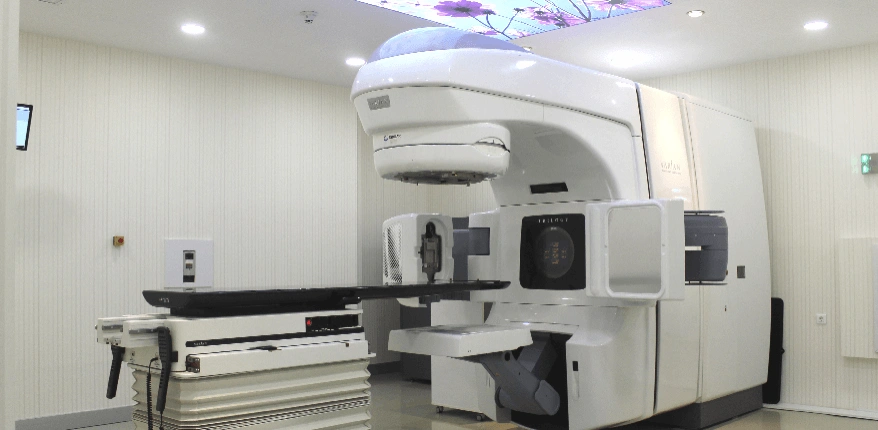
Radiotherapy Device And Features Used In Our Hospital
Our hospital uses the Trilogy Linear Accelerator (LINAC), which is equipped with five different radiotherapy techniques: Conformal, IMRT, VMAT, SRS, and IGRT. It is used for both diagnostic and therapeutic purposes.
3D Conformal
In 3D conformal radiotherapy, treatment planning is done using CT images, outlining the 3D tumor volume and critical organs. The aim is to deliver a dose distribution that surrounds the tumor as closely as possible, while minimizing exposure to healthy tissues, by using the multi-leaf collimators (MLC) of the linear accelerator.
IMRT
Intensity-Modulated Radiation Therapy (IMRT) adjusts the intensity of the beams in the treatment area to achieve an optimal dose distribution. This allows high doses to be delivered to the tumor while maximally protecting healthy tissues.
VMAT
Volumetric Modulated Arc Therapy (VMAT) is a beam delivery technique that allows radiotherapy to be completed in a very short time. In VMAT, the image acquisition time is under 2 minutes, and with an additional 2–3 minutes for beam delivery, the entire daily treatment can be completed in about 4 minutes. MLCs move according to tumor and organ positions while the gantry and dose rate change during irradiation. Multiple arcs around the patient allow for precise high-dose delivery to the tumor with maximum protection of sensitive organs.
SRS
Stereotactic Radiosurgery (SRS) delivers pinpoint radiation to very small tumors with millimeter precision. This allows high doses to be applied to the tumor while minimizing exposure to surrounding normal tissue.
IGRT
Image-Guided Radiation Therapy (IGRT) uses imaging to guide radiotherapy. Using an X-ray source and detector mounted on robotic arms, IGRT allows 2D evaluation by comparing kV-kV images with digitally reconstructed radiographs (DRR) from the planning CT. More importantly, by rotating around the patient, a CT image can be obtained and compared in 3D with reference images from the simulation, minimizing setup uncertainties, especially those caused by organ motion.
HLYCON
LYCON is one of the advanced radiotherapy systems used in the field of radiation oncology. This device allows millimetric precision imaging of tumorous tissue, supporting the controlled targeting of radiation beams to the intended area. In this way, the accuracy of treatment planning is increased, while aiming to protect the surrounding healthy tissues.
Thanks to HLYCON’s advanced imaging and patient monitoring systems, the patient’s position can be monitored in real time during treatment. When necessary, automatic adjustments made by the system help ensure that the radiation is delivered as planned. This feature supports safety and consistency in radiotherapy applications.
The technological infrastructure provided by the device allows for the optimization of radiotherapy session durations. Shorter and more controlled sessions contribute to increased patient comfort and help ensure that the treatment process proceeds in a planned and predictable manner.
At Emsey Hospital’s Radiation Oncology Clinic, HLYCON technology is evaluated based on the patient's clinical condition, diagnosis, and multidisciplinary assessments. Applications are planned in accordance with current scientific guidelines and Ministry of Health regulations.