
Spine Surgery
What Is Spine Surgery?
"Spine surgery" is a surgical specialty that deals with the conservative, interventional, and surgical treatments of spinal and spinal cord disorders seen in children, adolescents, and adults. Physicians specializing in this field are called “spine surgeons.”
A “spine center” is an advanced medical unit coordinated by a spine surgeon, where health professionals such as orthopedic surgeons, neurosurgeons, neurologists, rheumatologists, physiotherapists, and nurses work together with a multidisciplinary approach. All the needs of spine patients can be met under one roof in these centers, using the latest scientific knowledge and advanced technological facilities.
Spinal Disorders And Their Symptoms
The spine has two main functions:
- To ensure that the body is both mobile and upright.
- To protect the spinal cord — the “neural highway” that carries communication between the brain and the organs — from trauma.
Therefore, spinal disorders can present with various symptoms such as pain, postural deformities, numbness or tingling in the arms and legs, restricted mobility, loss of strength, urinary incontinence, or paralysis.
Main Categories Of Disorders That May Cause These Symptoms
Spinal Deformities
A deformity is defined as the “distortion of normal shape.” In some cases, it may not cause functional problems, but often, deviations from the normal spinal structure can cause pain, neurological issues, and functional impairments, disrupting the overall balance of the body.
- Scoliosis, kyphosis, and trauma are major causes.
- Some deformities are congenital (present at birth), while others are acquired later in life.
- Depending on severity and symptoms, some deformities can be monitored with conservative methods, while severe cases may require surgical correction.
Degenerative Spinal Diseases
These diseases disrupt the anatomical structure and impair normal functions. Examples include damage to intervertebral discs, disc herniations, and osteoarthritis of spinal joints.
- These conditions may compress neurological structures, causing pain, weakness, sensory loss, or urinary incontinence.
- When conservative treatments are insufficient to ensure daily comfort, surgical intervention may be necessary.
Spinal Trauma
Minor or major trauma can cause spinal injuries, sprains, or fractures. Major trauma often requires surgical stabilization to restore spinal integrity.
Spinal Tumors
In addition to primary spinal tumors, metastases from other body regions to the spine are common. Tumors can be invasive and destructive, requiring a multidisciplinary approach including surgery, chemotherapy, and radiotherapy.
Spinal Infections
The spine can be affected by various infectious diseases. While many cases can be treated with braces and medication, some require surgical intervention.
Main Surgical Methods In Spine Surgery
- Decompression – Relieving pressure on neurological or vascular structures, often performed with minimally invasive, endoscopic microsurgery techniques for faster recovery.
- Stabilization – Restoring stability to the spine after trauma, degeneration, or inflammation, often using spinal fusion techniques.
- Reconstruction – Rebuilding the structure and movement of the spine in advanced cases.
Common Procedures Include:
- Discectomy / Microdiscectomy – Partial removal of damaged discs to relieve nerve compression.
- Disc Prosthesis – Replacing removed discs with artificial implants.
- Laminectomy / Laminoplasty – Removing part or all of the bone covering the spinal canal to widen it.
- Corpectomy – Removing part or all of one or more vertebrae.
- Vertebroplasty – Injecting bone cement into the vertebra for stabilization.
Scoliosis
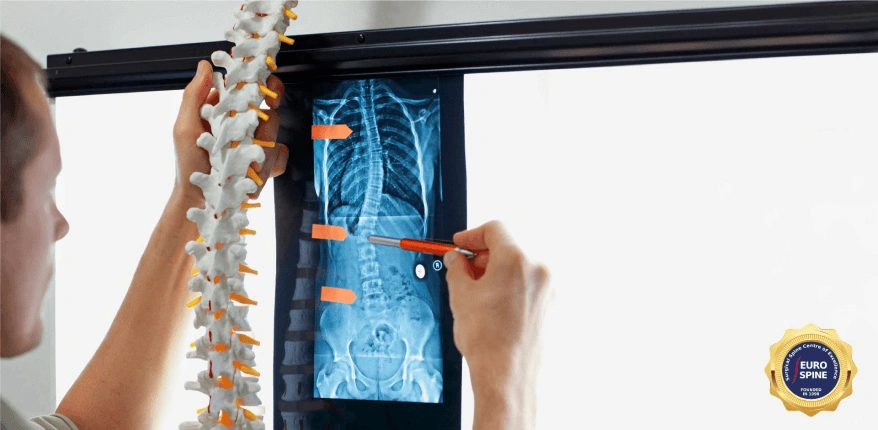
Definition: A lateral curvature of the spine visible from the front or back, often with a three-dimensional rotational component.
Causes:
- Idiopathic Scoliosis – Most common type (≈80%), cause unknown, more frequent in girls.
- Congenital Scoliosis – Caused by malformations during fetal development.
- Neuromuscular Scoliosis – Secondary to neurological conditions such as spina bifida, cerebral palsy, or muscular dystrophy.
- Functional Scoliosis – Non-structural, temporary curvature often due to posture, muscle strain, or leg length differences.
Symptoms:
- Uneven shoulders or hips
- Asymmetrical waist curves
- Visible rib hump or back deformity
- Back pain
- Clothes not fitting evenly
- In severe cases: breathing difficulties
Diagnosis:
- Primarily by X-ray (Cobb angle measurement)
- Mild: 10–20°, Moderate: 20–40°, Severe: >40°
- Additional tests: MRI, CT, EMG, lung function tests, bone density scans.
Treatment:
- Observation and exercises for mild cases
- Bracing for moderate cases in growing children
- Surgery for severe curves (>40°) or progressive deformities
Modern Surgical Options:
- Spinal Fusion – Correcting and stabilizing the curve with rods and screws.
- Tethering (VBT) – A fusionless technique that allows continued spinal growth and flexibility.
Kyphosis
Definition: Excessive forward curvature of the upper spine (hunchback).
Causes: Poor posture, Scheuermann’s disease, trauma, osteoporosis, congenital malformations.
Treatment:
- Posture correction and exercise in mild cases
- Bracing for certain progressive cases in growing patients
- Surgery (spinal fusion or tethering) for severe deformities
Why Choose Emsey Spine Surgery?
- First and only “Center of Excellence” certification in spine surgery in Turkey and Asia
- Globally recognized academic team contributing to medical literature
- Multidisciplinary, innovative approach
- Comprehensive care including psychological, nutritional, and rehabilitation support
- 24/7 availability with advanced diagnostic and treatment facilities