

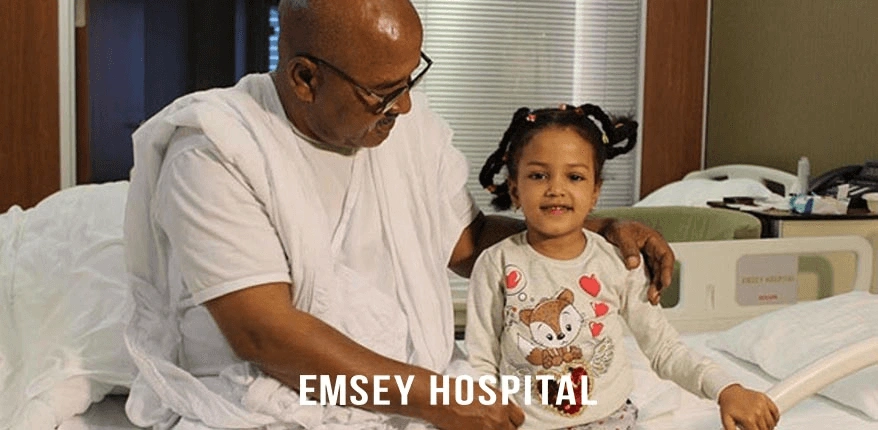
Little Girl from Mauritania Walked in Turkey
Five-year-old Selekha, the youngest child of the Mohamed family living in Mauritania, returned from the hospital at the age of 1.5 after being told she had a tumor completely covering her spinal cord, which was discovered when she was taken in with high fever. Doctors told the family, who traveled from country to country for their daughter’s recovery, that she would “never walk again.” The little girl regained her health thanks to surgery performed by Turkish surgeons.
Five-year-old Selekha Mohamed went to the hospital 3.5 years ago due to high fever. Initially thought to have lung problems, she was first diagnosed with bronchitis, then with tuberculosis, and received tuberculosis treatment for a while but did not recover. Later examinations revealed that Selekha had a tumor in her spinal cord, and doctors said she would be paralyzed and never walk again. The family, who traveled across four countries for their daughter’s survival, received positive news from Turkish surgeons. The little girl, who had difficulty walking and maintaining balance, walked in Turkey after an 11-hour surgery.
“DADDY, I CAN’T WALK!”
Osman El Abid Mohamed, the father of the little girl who traveled through four countries including Tunisia, Senegal, Spain, and Turkey for his daughter’s recovery, said no doctor wanted to operate on her, claiming the surgery would not be successful and she would be paralyzed within a few years.
Not giving up on the fight for his daughter, the father said he found the solution in Turkey and told DHA about his experience:
“When my insurance company found this hospital, I came to Turkey without hesitation. When we arrived here, my daughter had already begun to lose balance and strength. This situation scared me a lot. Selekha was aware of what was happening and was complaining, saying ‘Daddy, I can’t walk.’”
EVEN THE POSSIBILITY OF DISABILITY WAS OUR HOPE
Describing the severity of his daughter’s pain, the father said: “My daughter was in great pain, and we didn’t know what to do because of it. I couldn’t care about the risks of the surgery. Even the possibility of her being disabled was a hope for me because at least she would be relieved of her pain. I had no hope that she would recover. I never thought she would walk again. I knew the surgery would be very difficult. It was a surgery that lasted from 9 a.m. to 8 p.m. My daughter, whom I feared losing, was saved here. I am very happy.”
THEY TREATED ME LIKE FAMILY IN TURKEY
The father, Mohamed, explained that Selekha has five more siblings in their country and her mother could not come to Turkey because she had to take care of them. He said people in Turkey treated him like family:
“They hosted me very well. The doctors spoke to me very honestly. They explained both the good and bad sides of the surgery. They told me it was risky but could also be successful. I really trusted their sincerity and optimistic approach. I thank them all.”
“IT IS SEEN MORE IN CHILDREN”
Prof. Dr. Ali Ender Ofluoğlu, Brain and Nerve Surgery Specialist at Emsey Hospital, who performed the little girl’s surgery, stated: “Spinal cord and brain tumors can be seen more in children compared to adults. Apart from metastases, we cannot exactly know their cause. Brain and spinal cord tumors seen in children are usually more benign than those in adults, but their location is always problematic. However, by using technology, we can successfully perform these surgeries in our country. As Turkish physicians, we are truly successful in surgeries. We are well-trained and courageous.”
“SHE WILL CONTINUE HER LIFE AS IF SHE HAD NEVER HAD SURGERY”
Prof. Dr. Ofluoğlu stated: “When her films were brought to us for consultation, we saw a tumor inside the spinal cord. Tumors inside the spinal cord at this age are generally benign, but removing such a tumor from a spinal cord the size of a finger was extremely difficult. During the surgery, we used technology that allowed us to monitor nerve damage. If we had not performed this surgery, the tumor would have grown and caused her to lose both legs. After this operation, she may never need another spinal surgery again. If you cut and leave the back bones of the spine at 7-8 levels, kyphosis could occur, so to prevent this we cut and then reattached them. As a teenager, she will continue her life as if she had never had surgery.”